
Guest post by Gabby Taylor
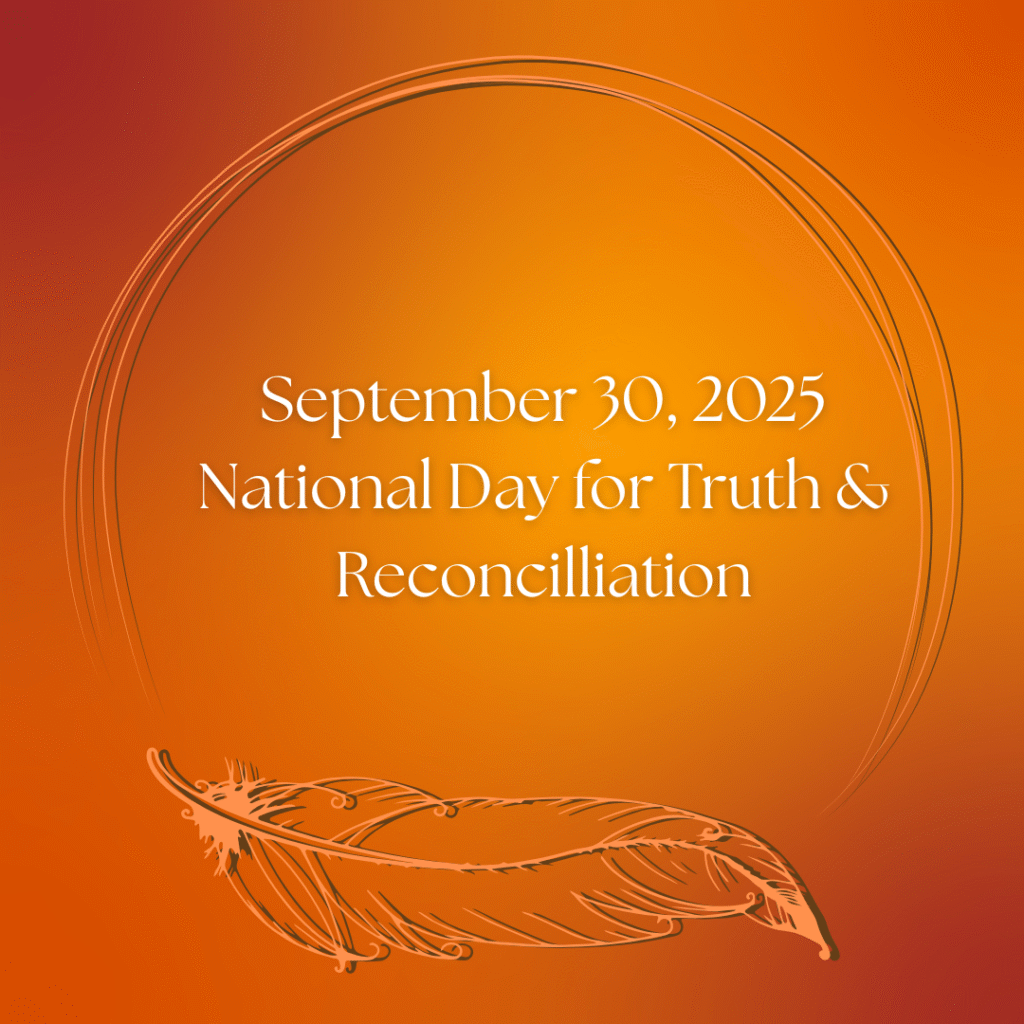
Orange Shirt Day and the National Day for Truth and Reconciliation are a time to remember, honour, and act. First observed in 2013, Orange Shirt Day was inspired by Phyllis Webstad, a survivor of the St. Joseph Mission Residential School in British Columbia. On her first day of school, Phyllis proudly wore a brand-new orange shirt that her grandmother had given her. The shirt was immediately taken away and never returned. Her story has become a powerful symbol of how residential schools stripped away Indigenous children’s belongings, culture, language, and sense of self.
The day serves as both a memorial for the children who never returned home and a show of solidarity with survivors and their families. In 2021, the federal government established September 30 as the National Day for Truth and Reconciliation, giving the day official recognition and inviting all Canadians to pause, reflect, and act on the truths of our shared history.
National Truth and Reconciliation Day is about more than a single day. It’s about truly understanding our history and the horrific truths that lay within the walls of residential schools. It’s about pausing to reflect on how we can better amplify Indigenous voices, listen to survivors, and commit to act as individuals, communities, and organizations. It also means recognizing the long-standing impacts of residential schools and the intergenerational trauma that continues to affect Indigenous peoples, including the Two-Spirit community whose roles and identities were suppressed by colonization.
As an organization, we are working every day to better understand these impacts and to step into reconciliACTION—choosing action over symbolism. One way we do this is by looking to the TRC Calls to Action as a guide. Call to Action 92 asks businesses and organizations to commit to reconciliation by adopting the United Nations Declaration on the Rights of Indigenous Peoples (UNDRIP) as a framework, ensuring equitable access to opportunities, and providing education on Indigenous rights and histories. For us, that means acknowledging how these commitments intersect with queer and Two-Spirit identities. Two-Spirit people often experience racism and homophobia and/or transphobia simultaneously. Creating safe, inclusive, and affirming spaces where all Indigenous identities are respected is central to advancing reconciliation.
We also recognize that reconciliation must include supporting Indigenous entrepreneurs and workers, including Two-Spirit business owners, by creating opportunities, amplifying voices, and breaking down barriers to participation. A small step we’ve taken is offering free membership to our indigenous community members, as part of our effort to increase accessibility, learning, and engagement while we continue to educate ourselves and others.
But reconciliation is not something one organization or community can do alone. It requires allyship and solidarity from everyone. That means taking time to learn, challenging colonial systems, making space for Indigenous voices, and ensuring that commitments to change are followed by real action.
Call to Action 92 isn’t just about jobs and training—it’s about reshaping workplaces and organizations into spaces where Indigenous people, including queer and Two-Spirit folks, can thrive with dignity, respect, and full recognition of their identities. That’s the work we are committed to carrying forward—and we invite our members, partners, and community to join us.
Reconciliation isn’t only about September 30; it’s about the choices we make and the actions we take every day.

